If you’re still chasing backlinks using 2015-year-old methods, I have bad news.
At SEO-Mind42, we noticed a strange trend a year and a half ago: clients with powerful backlink profiles began losing rankings. Meanwhile, projects with minimal backlinks but an active PR presence were growing.
At first, it seemed like a coincidence. Then the numbers became obvious.
Artificial intelligence is rewriting the rules of the game. Google AI Overviews, ChatGPT, Perplexity — now they decide whom to show users.
Classic backlinks are taking a back seat. Brand mentions and citations in AI answers are moving to the forefront.
What this article is about
We’ll cover three sections:
Section 1: Why traditional link building no longer works
Section 2: How AI models assess authority through mentions
Section 3: Specific techniques for earning mentions (with examples and tools)
Let’s figure it out.
What happened to backlinks
Ten years ago, SEO specialists lived by a simple formula: more links = higher rankings.
Bought 500 links from PBNs? Great, you’ll shoot to the top.
Exchanged links with 50 sites? Not bad either.
That model has broken down.
The Ahrefs study that changed everything
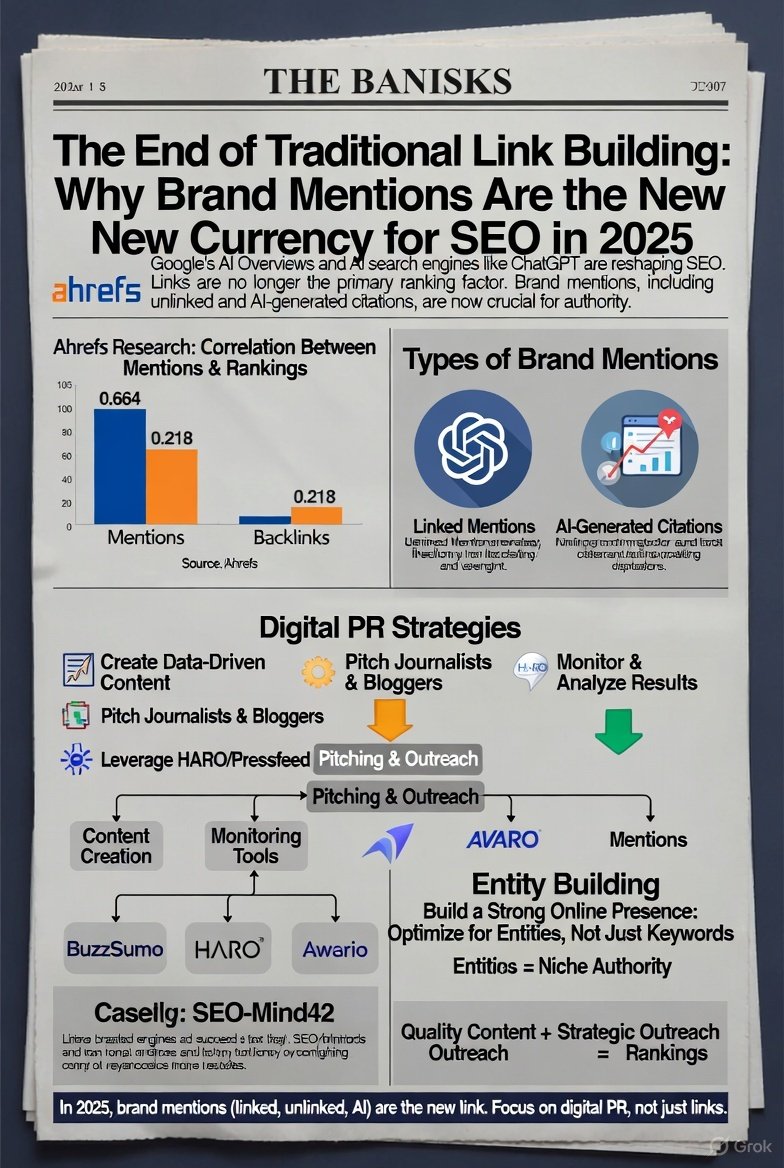
The Ahrefs team analyzed 75,000 brands. The goal: to understand what affects inclusion in Google AI Overviews (AI answer blocks in search results).
The results were shocking:
| Factor | Correlation |
|---|---|
| Number of backlinks | 0.218 |
| Brand mentions across the web | 0.664 |
Mentions turned out to be three times more important than links for appearing in AI Overviews.
Three times, Carl!
Why this happened
Google has learned to understand context without hyperlinks.
Previously, the algorithm saw only direct connections. A link = trust. No link = nothing.
Now neural networks recognize a mention of your brand on an authoritative resource and understand: it’s a recommendation.
Imagine the difference:
Old model: Counting votes in an election. The more, the better.
New model: Listening to what experts say behind the scenes. The quality of opinions matters more than the quantity.
A Forbes editor-in-chief may mention your product in an article without a link. Before, that accomplished nothing. Now it’s gold.
Personal experience
Two years ago, we promoted an online store selling premium cosmetics. The client spent ₽800,000 purchasing links from trusted sites. Result: +12% traffic over 6 months.
At the same time, we launched another project — handmade jewelry. The budget went toward PR: publications in lifestyle outlets, interviews with the founder, and collaborations with bloggers. Links were far from universal.
After 6 months: +67% traffic. Plus, the brand began appearing in ChatGPT answers to queries like "where to buy artisan earrings."
A coincidence? We checked with three other clients. The trend was confirmed.
Three types of mentions in 2025
Let’s take a detailed look at what counts as a mention and how it works.
Type 1: Link Mentions
Classic backlinks. Yes, they still carry weight.
A quality link from an authoritative site is a strong signal, especially when it appears in the context of an expert article.
But now it is neither the only nor the main factor.
Type 2: Unlinked Mentions
Your brand, product, or CEO’s name appears on a website, without a clickable link.
Example:
"We use Yandex Metrica for analytics and Rank Math for SEO audits."
Rank Math is mentioned, but not linked. This used to be ignored. Now it affects rankings.
Why this works
An Editorial.Link survey of 518 SEO specialists showed that 80.9% believe unlinked mentions directly affect rankings.
The logic is simple: mentions are harder to manipulate. You can’t buy batches of mentions on marketplaces the way you can buy links. It’s a more organic authority signal.
Type 3: AI Mentions
Your brand is mentioned in an answer from ChatGPT, Claude, Perplexity, or Google AI Overview.
This is a new level of visibility.
The Zapier case
Zapier does not have the strongest backlink profile compared with its competitors. But its content is so useful that it is cited everywhere.
Result: AI models constantly recommend Zapier as an automation solution.
They built authority through content and mentions, not thousands of purchased links.
Statistics from Ahrefs
Brands in the top quartile by number of mentions receive 10 times more citations in AI Overviews.
A tenfold difference. Think about that.
Digital PR as the new link building
If mentions are the new currency of authority, how do you earn them?
The answer: Digital PR.
Numbers you can’t ignore
The Digital Loft agency tracked five brands over two years. The companies engaged in digital PR systematically.
Result: an average of +124% organic traffic over two years.
This is not a margin of error. It is a doubling of the audience through earned mentions and authority.
What digital PR looks like in practice
It’s not just press releases sent into the void.
The strategy includes:
- Creating newsworthy stories that journalists will want to cover
- Producing data and research
- Building relationships with editorial teams
- Expert commentary in industry media
- Collaborations with other brands
The global PR market will grow to $133 billion by 2027. Smart companies are shifting budgets from buying links to building brands.
The new reality: zero-click search
AI Overviews are taking over search results
Google shows AI Overviews for approximately 30% of queries. But for problem-oriented questions (which is what your customers’ queries are), the figure reaches 74%.
The user gets an answer directly in the search results. There’s no need to click.
If your brand isn’t in that answer, you are invisible.
A new metric: share of voice in AI
Before, we counted how many clicks we received from search.
Now we count how often AI recommends us instead of our competitors.
When someone asks ChatGPT "the best CRM for small business," what does it answer? Your product or someone else’s?
What language models look for
AI analyzes several parameters:
Prevalence: How often your brand is mentioned across the web
Co-occurrence: Whether you are mentioned alongside other authorities
Context: In what tone and context people talk about you
Recency: Recent mentions carry more weight
The value of traffic from AI
Some studies show that traffic from LLMs is worth 4.4 times more than ordinary organic traffic.
Why? The user has already received a recommendation from AI. Their intent is extremely strong. They arrive ready to take action.
A real example
Recently, I was looking for courses on building confidence for a child. I asked Google AI.
I received three recommendations with a brief description of each. I went to the first one, looked it over, and bought it.
The entire journey took 10 minutes. I didn’t browse dozens of sites. AI did the preliminary selection for me.
This is where search is heading.
Strategy 1: Creating content people will mention
The theory is over. Let’s move on to tactics.
The relevance-sphere method
Imagine your brand as the core. Around it are concentric circles of adjacent audiences.
Let’s take our SEO-Mind42 agency:
Core: SEO promotion
Sphere 1: Small-business owners
Sphere 2: Internet marketers
Sphere 3: Website developers
Sphere 4: Content managers
We create a relevant news hook for each sphere.
Example for the "Small-business owners" sphere:
"Study: 43% of small businesses ignore local SEO and lose 60% of potential customers"
This is interesting to a specific audience and tied to our expertise.
The formula for a compelling headline
Bad example:
"Statistics on SEO use by Russian companies"
Problems: too broad, nonspecific, boring.
Good example:
"Every third Moscow coffee shop loses ₽200,000 a year because it is absent from Google Maps"
Why it works: a specific niche, numbers, financial damage, and a local connection.
Checklist before launching a campaign
Before investing money, test the idea:
- Why does it matter? What problem does the information solve?
- What is unique? Is this data available elsewhere?
- Is it advertising? If so, journalists won’t pick it up
Journalists don’t write about "our amazing product." They write about interesting trends and data.
Your task: package your expertise in a newsworthy format.
Where to find examples
Go to vc.ru’s "Marketing" section or Sostav.ru.
Look at the headlines of popular articles:
- "How X company increased Y by Z%"
- "Study: almost half of startups make this mistake"
- "We tested 50 tools. Here are the best ones"
Analyze the structure. Adapt it to your niche.
Strategy 2: Five types of data for PR campaigns
I’ll demonstrate using a local business as an example. Suppose you provide air-conditioning maintenance in Moscow.
Type 1: Generational differences
Conduct a survey among different age groups:
- Do you use the air conditioner when no one is home?
- What temperature do you keep your apartment at?
- Have you ever slept without air conditioning to save money?
- Do you use smart thermostats?
We get the data. We create the material:
"Zoomers keep their apartments 5°C warmer than boomers to save money"
It works because it:
- Creates a discussion between generations
- Is relevant to current economic problems
- Is easy to illustrate with charts
Type 2: Regional rankings
Collect data by Moscow district:
- Average air-conditioner repair costs by district
- The most common breakdowns by district
- Energy consumption by district
- Districts with the oldest systems
We create the material:
"Residents of these five Moscow districts pay ₽50,000 more for air-conditioning maintenance"
Why it grabs attention:
- Hyperlocal content
- It evokes pride or concern among district residents
- Local media love this kind of story
Type 3: Emotional confessions
Survey people:
- What is the longest you endured without air conditioning before calling a technician?
- Did you try to fix it yourself and make things worse?
- What was the most desperate way you tried to cool down?
Result:
"One in three Muscovites admitted sleeping in their car when their air conditioner broke during a heat wave"
It works because of:
- Surprising human behavior
- Visual appeal (you can shoot a video)
- The emotional element
Type 4: Technological anxiety
The topic: how much do people trust AI to manage the climate?
Questions:
- Would you trust AI to automatically regulate the temperature in your home?
- Are you concerned about the data collected by smart thermostats?
- Would you agree to remote diagnostics through AI?
- Would you prefer a human technician or automation?
The material:
"67% of Muscovites do not trust AI to control the temperature in their homes"
Relevant because of:
- Smart-home trends
- General anxiety about AI
- The privacy debate
Type 5: Financial behavior
Find out what air-conditioner owners regret:
- Have they skipped maintenance to save money?
- Have they postponed a repair that later became more expensive?
- Have they chosen the cheapest contractor and regretted it?
- Which expenses came as a surprise?
Result:
"Skipping ₽4,000 worth of maintenance costs Muscovites an average of ₽45,000 in emergency repairs"
Convincing because of:
- Specific loss figures
- Fear of missing out on savings
- Practicality
The main rule
Even if you are a small local company, once the media, blogs, and Telegram channels begin citing your data, you will become an authority in your field.
Strategy 3: Media outreach
The content is ready. Now you need journalists to learn about it.
Two approaches: active hunting and passive fishing.
Active hunting: pitching journalists
You can’t simply send a press release to 500 addresses. That’s spam.
You need sniper-like precision.
Three questions before a pitch
1. Specialization
Does this journalist write about your topic? Don’t offer an SEO story to a sports reporter.
2. Geography
Do you have local data? Send it to local outlets. They love regional stories.
3. Publication history
Does this author publish studies and surveys? Search the publication’s website.
Tools for finding journalists
For the Western market:
- Muckrack
- Cision
- Buzzsumo
For the Russian market:
- Pressfeed
- Telegra.ph (search by media Telegram channels)
- Directly search for editorial contacts on publication websites
Passive fishing: HARO and alternatives
HARO (Help A Reporter Out) is a platform where journalists look for experts.
How it works:
- A journalist posts a request: "Looking for an email-marketing expert for an article in Forbes"
- You respond with an expert comment
- If the response is suitable, you receive a mention (often with a link)
Russian alternatives
Pressfeed.ru — the largest platform. Journalists publish requests, and experts respond.
Principle.ru — a similar service, but smaller in scale.
Editorial Telegram channels — many publications run channels where they look for people and experts for their materials.
Example request
"We're looking for small business owners who promote themselves through SEO. Tell us about your experience for an article on VC.ru"
You write a detailed response with specifics. A week later, an article featuring your comment and a mention of your company is published.
Balancing the two approaches
Active hunting — for large campaigns with your data
Passive fishing — for a regular flow of small mentions
Hunt big game. Fish every day.
Strategy 4: Monitoring and working with mentions
You need to track every mention of your brand online.
Monitoring tools
Google Alerts
Free. Basic functionality.
Create an alert for "SEO-Mind42" (must be in quotation marks, otherwise there will be separate notifications about SEO and Mind).
Every day, emails arrive with new mentions.
Brand24
Paid service. It catches mentions in social media, blogs, forums, and the news.
It shows sentiment (positive/negative), reach, and trends.
YouScan
A Russian alternative. It monitors mentions and analyzes visual content (your logo in photos).
Mention
An international tool. Works in real time.
Link Reclamation
Found a brand mention without a link on an authoritative website?
Write to the author:
Hi, [Name]!
Thank you for mentioning SEO-Mind42 in the article "[title]". Great piece!
It would be useful for readers to add a link to our blog, where the topic of [specific topic] is covered in more detail. Here is the page: [URL]
We'd appreciate it!
Short, polite, and focused on specific value. The conversion rate for such requests is around 20-30%.
Strategy 5: Strengthening the brand for AI
Help Google and language models understand who you are.
Presence on key platforms
Wikipedia
If the brand is well-known enough, create a Wikipedia page. The rules are strict: you need independent sources confirming its notability.
Crunchbase
For IT companies and startups. Fill out your company profile. AI often takes data from there.
Industry directories
Depending on the niche: ProDoctorov (medicine), Houzz (design), RBC Companies (any business).
NAP consistency
NAP = Name, Address, Phone
In all directories, on the website, and on social media, use the same spelling of the name, address, and phone number.
Google uses this to verify the brand.
Entity-rich content
Every piece of your content should include mentions of related entities.
Bad:
"We help with promotion"
Good:
"The SEO-Mind42 team works with Yandex Metrica, Google Analytics 4, and sets up connections through Google Tag Manager to track conversions in CRM systems such as Bitrix24 or amoCRM"
AI sees the connections between your brand and other well-known entities. This strengthens contextual understanding.
Strategy 6: Stimulating branded searches
When people search for your brand by name, Google understands that you are a recognizable entity.
How to stimulate branded searches
Agoda case study
Their advertising does not simply sell cheap tickets. It teaches people to search for "Agoda cheap tickets" rather than just "cheap tickets."
They reprogram search behavior to get ahead of competitors at the start of the customer journey.
One.com case study
Remember the ad about the guy who builds a website with calls from click swans?
The video is so strange and memorable that later, when you think "I need to build a website," you remember "that guy with the swans from One.com."
The result: searches for "build a website one.com" instead of simply "build a website."
How to apply it
Create advertising that:
- Tells a vivid story featuring your brand
- Solves a specific problem
- Subtly embeds the association "problem + your brand" in people's memory
The goal is not a direct sale. The goal is for people to remember your name and type it into search when a need arises.
Measuring results
What metrics should you track in 2025?
Traditional metrics (still important)
- Organic traffic
- Rankings for key queries
- Number of quality backlinks
- Domain Rating / Domain Authority
New metrics (critical)
Number of mentions per month
Growth = growing authority
Share of AI Overviews
How often your brand appears in AI answers to niche queries
Citations in ChatGPT/Claude
You can check manually: ask questions from your niche and see whether AI recommends you
Branded search volume
Track it in Google Search Console and Yandex Webmaster
Mention sentiment
Positive/Negative/Neutral — context matters, not just the quantity
Measurement tools
| Metric | Tool |
|---|---|
| Unlinked mentions | Brand24, Mention |
| Branded query trends | Google Search Console |
| Backlinks | Ahrefs, Serpstat |
| AI Citations | For now, manually or through in-house solutions |
| Sentiment | YouScan, Brand24 |
Our experience: three case studies
Case 1: B2B SaaS for HR
Objective: Increase visibility in a narrow niche
Timeline: 8 months
PR budget: ₽450,000
Actions:
- Conducted a study titled "Burnout among HR professionals in 2024"
- Surveyed 320 HR professionals
- Pitched the data to 15 specialized publications
- Secured 9 publications (VC.ru, Habr Career, RBC Trends)
Results:
- Brand mentions: +340% over the period
- Organic traffic: +89%
- Appeared in ChatGPT answers for 7 queries out of 10 target queries
- Organic leads: +120%
Case 2: Local dental clinic network (Yekaterinburg)
Objective: Reach the top 3 in the city
Timeline: 5 months
Budget: ₽180,000
Actions:
- Collected district-level data: average bill, popular procedures, and patients' fears
- Launched a series of publications in local media and Telegram channels
- The CEO provided expert comments through Pressfeed
- Sponsored a local study titled "Dental health among Ural residents"
Results:
- Reached the top 3 in Google Maps for 12 key queries
- Mentions in 23 local sources
- Calls from organic search: +200%
- Brand awareness in the city (survey): increased from 8% to 34%
Case 3: Online marketing school
Objective: Break into a saturated niche
Timeline: 12 months
Content and PR budget: ₽850,000
Actions:
- Monthly mini-studies of marketing trends
- The founder became a regular expert in 5 industry media outlets
- Launched a podcast with guest speakers (cross-audience)
- Actively responded to journalists' requests through Pressfeed
Results:
- 87 mentions in specialized media outlets over the year
- Organic traffic: +340%
- Appeared in AI Overviews for 15 educational queries
- Lead conversion: increased from 2.1% to 5.8% (improved audience nurturing)
- Digital PR ROI: 420%
Common mistakes in digital PR
We see them regularly among clients who come to us after an unsuccessful experience.
Mistake 1: Promotion instead of data
They try to force product advertising into a study. Journalists can spot it a mile away and reject the material.
Mistake 2: Mass mailing
One press release sent to 300 editorial offices. No personalization. The result: everyone ignores it.
Mistake 3: No follow-up
They send a pitch and wait. After 3 days without a response, they give up. But they should gently remind the recipient about themselves.
Mistake 4: Boring data
"80% of companies use email marketing" — this is not news. Everyone knows it. Unexpected insights are needed.
Mistake 5: Ignoring monitoring
You receive a mention and do not notice it. You miss the chance to thank the author, share it, and build a relationship.
What to do right now
If you've read this far, here is a specific action plan for the next 30 days:
Week 1: Audit your current position
- Set up Google Alerts for your brand name
- Check your current mentions through Ahrefs/Serpstat
- Find 5-10 unlinked mentions from the past 3 months
- Write to the authors asking them to add a link
Week 2: Market research
- Study what your competitors are writing about
- Find 10 journalists covering your topic
- Subscribe to Pressfeed or register with HARO
- Make a list of 5 research ideas
Week 3: Create your first asset
- Choose one idea from the list
- Conduct a survey (at least 100 respondents)
- Or collect public data and find an insight
- Package it into a piece of content with a compelling headline
Week 4: First pitch
- Write personalized emails to 10 journalists
- Send the material
- Respond to 3-5 expert requests through Pressfeed
- Analyze what worked and what did not
In a month, you will have your first experience. Your first mentions. Your first data for analysis.
Then repeat the cycle, improving every element.
A no-fluff conclusion
Link building is not completely dead. It has simply stopped being the only and most important thing.
AI is changing the rules. Brand mentions, context, and authority in the eyes of real people — that is what now moves websites to the top.
Digital PR is not magic. It is systematic work to create news hooks and build relationships with those who shape the information landscape.
Companies that switch to this logic now will gain an advantage of 2-3 years. The rest will be playing catch-up.
At SEO-Mind42, we have already reoriented all our clients' strategies. The results confirm that this is the right direction.
If you still have questions about your specific niche, write in the comments. We will analyze your situation.
This material is based on an analysis of 30+ international and Russian studies and the team's practical experience promoting 50+ projects at SEO-Mind42. Updated: December 2025.