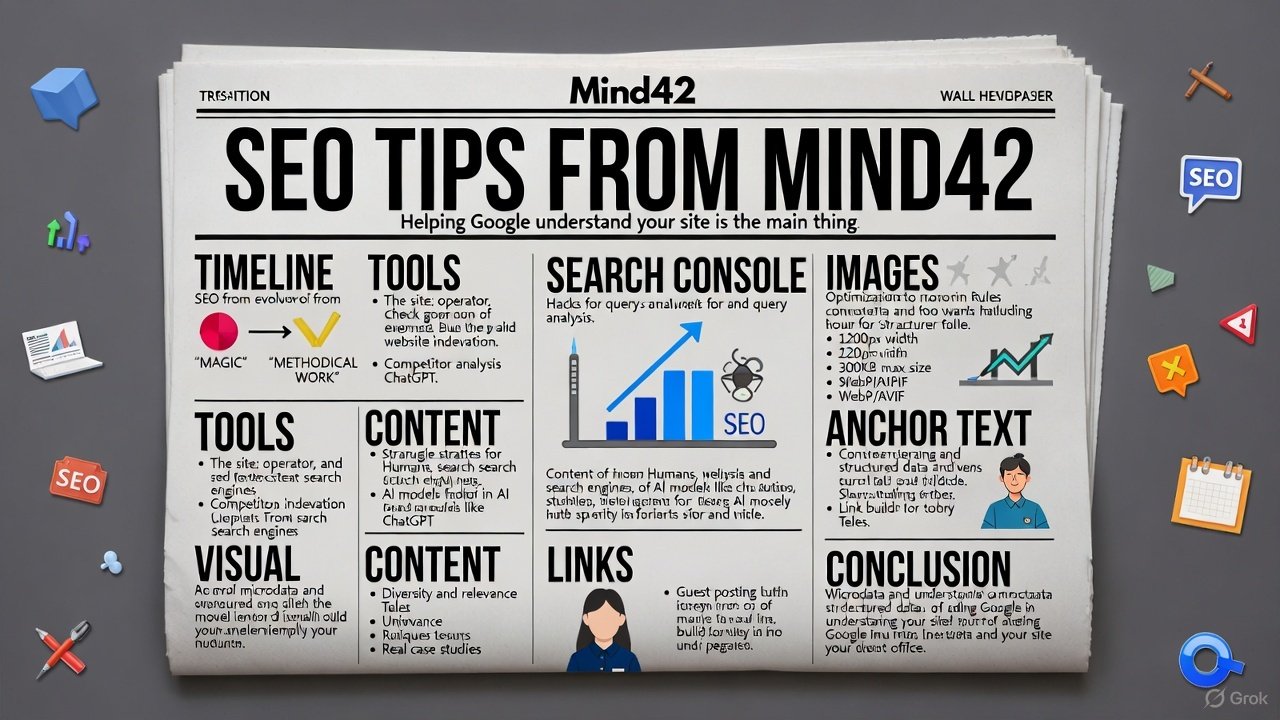
When we were just starting out in SEO, it seemed that success depended on “the right plugins” and “secret settings.” Over time, it became clear that search engine optimization isn’t magic—it’s consistent work, observation, and common sense. This article brings together the things we actually use every day. No academia, no myths—just methods that work.
Search That Helps You Find More Than Just Pages
The most underrated tool is the operator site:. It can help you check whether a page is indexed, track competitors’ publications, and even search for documents on government domains.
We often show clients a simple approach:
| Goal | What to enter in Google | What you see |
|---|---|---|
| Check whether a specific page is indexed | site:example.ru/страница |
If there’s a result, the page is indexed |
| Find content on a topic on a competitor’s site | site:competitor.ru "SEO" |
A list of relevant publications right away |
| Find PDF reports on government websites | site:.gov filetype:pdf "annual report" |
All available reports in one place |
These commands are useful for both marketers and analysts. We often use them to find fresh sources for content strategies.
Content Now Has Three Audiences
Today, text is read not only by people and search bots. They’re joined by language models — ChatGPT, Claude, Perplexity, and others. They don’t scan the whole page; they read in chunks, known as chunks. That’s why each section needs to make sense on its own.
When we write articles, we try to make sure each section fully explains an idea. If we talk about “voice search optimization,” we don’t spread the definitions across the page; instead, we group all the related terms right away: voice search, speech recognition, mobile assistants. This helps models understand the context and connect concepts.
The same principle applies to abstract words. Instead of “add visual elements,” we write “add lists, tables, images, and subheadings.” The more concrete the set of entities, the clearer the meaning is for both LLMs and readers.
How to Write for People, Google, and Models
In the age of AI search, it’s important for the first sentence under each subheading to be short, specific, and packed with meaning. We make it directly answer the heading’s question so the system can use it as a snippet.
After that, we add paragraphs for people, with explanations, context, and examples.
This way, the same text remains easy to use for three types of “readers”:
-
people—who understand the meaning,
-
search engines—which can see the structure,
-
LLMs—which can easily pick out a complete thought.
Search Console Is More Than Just Charts
Most people look at Search Console for clicks and impressions. We use it to find new ideas.
In the “Queries” section, we use Regex filters to pull out users’ questions:
This makes it easy to see which topics are worth covering in an FAQ or new articles.
To find out which commercial queries a site is already ranking for, we filter for words like best, top, vs.
Another trick is to filter by query length, from short to long-tail queries. This helps us see where articles can be strengthened to target more specific queries.
After every content update, we check when the page was last crawled by a bot. If it’s been more than a month, we manually request reindexing. Every now and then, this doubles the speed of ranking growth compared with simply waiting for an update.
Images: Lightweight, Clear, and Eye-Catching
Google likes visual content, but only if it doesn’t slow down the site. Our basic rules are simple:
-
1200 pixels wide;
-
no more than 300 KB per file;
-
WebP or AVIF format;
-
alt text is required, preferably with a target keyword.
If a site uses Rank Math, we enable the Image SEO module and activate automatic alt tag generation from the filename. This saves us from the routine task of editing hundreds of images.
| Problem | Solution | Tool |
|---|---|---|
| Large files | Compress to 300 KB | Imagify, TinyPNG |
| Missing alt text | Add a description | Rank Math |
| Old JPG format | Convert to WebP | Online converter |
One more tip for Google Discover: the article’s main image should be 1200×628 pixels and not pixelated. We check this before every publication.
Anchor Texts and Link Logic
Links are the language websites use to communicate with each other. The problem is that many people repeat the same anchor text.
If every article links to another one using just “smartphones,” the search engine loses context. It’s better to use different variations:
-
best smartphone brands;
-
tips for taking photos with your phone;
-
affordable models for students.
Variety makes the structure feel natural, and algorithms can better understand the meaning of the connection between pages.
Content That Can’t Be Generated
Google is talking more and more about “information gain”—the addition of unique information. This is exactly what we call experience-based content.
Our articles always include specific cases, figures, and observations:
-
screenshots from Search Console,
-
real ranking changes,
-
the story of an experiment (“we added a table—CTR went up”).
You can’t rewrite this kind of material in someone else’s words. And it’s exactly what brings stable traffic.
Visual Structure and Structured Data
Before publication, we go through our internal checklist:
| Check | What we look at | Why it matters |
|---|---|---|
| Headings H1–H3 | Logical and not duplicated | Improve readability |
| First 100 words | Answer the key query | Affect CTR |
| Formatting | Lists, quotes, and tables are included | Make reading easier |
| FAQ schema | Markup is correct | Increases the chances of getting a rich snippet |
Many people forget about microdata, but it affects user behavior metrics. For example, FAQ sections increase click-through rates without additional links.
Guest Articles and Link Growth
When we need to expand our reach, we use the classic method of searching for guest posting opportunities.
A simple Google query:
or
This is how we find sites that accept posts in the right niche. It’s an old but effective way to get relevant links without unnecessary spam.
When Content Is Updated but Google Doesn’t Respond
Sometimes a page has been improved for a while, but its rankings don’t move. We check the date of its last crawl in Search Console.
If Google hasn’t noticed the update, we manually submit a reindexing request. In 7 out of 10 cases, we see results within a few days.
A Personal Note
We don’t write texts just to fill them with words. SEO is about meaning.
When you see that an article is helping people understand a topic instead of simply sitting in the search results, that’s what real optimization looks like.
Mind42 isn’t an agency that does “SEO for SEO’s sake.” We build a site’s logic so everyone can understand it: users, bots, and language models.
Conclusion
In 2025, effective SEO isn’t about clever schemes or chasing keywords. It’s about knowing how to explain complex things in simple words.
And if there’s one thing to remember from this whole article, it’s this:
Don’t trick Google—help it understand you.