
The website says: “We develop design documentation of any complexity.” In response, a photo of a housing arrives with the question: “How much will it cost?” The engineer does not understand whether there is a sample, whether a new design is needed, or who will manufacture it. The client does not know what else to add either.
The service page should help the client take the first step: describe the task, gather the available initial data, and understand the next outcome. To do this, show a recognizable situation and a specific way to get in touch.
Start with the reason for contacting you
Instead of a general promise, list the situations the team actually works with. For example: the product exists only as a sample; production has received an incomplete set; drawings exist, but do not match the actual implementation. If the service does not include examining a sample or calculating the design, explain this nearby.
Do not promise a price based on one photograph. Say what information will help determine the scope of work and what the engineer will still need to clarify. It is easier for a reader to answer a specific question than to fill in a field labeled “Describe everything in detail.”
Turn service language into client actions
| General phrase | What to write for the first inquiry |
|---|---|
| Individual approach | State what the set is needed for: manufacturing, approval by the customer, or another task |
| We work from a technical specification (TZ) | If there is no technical specification (TZ), describe the product’s purpose, known constraints, and desired outcome |
| Complete set of documents | After clarifying the task, we will agree on the list of documents, formats, and acceptance procedure |
| We will quickly calculate the cost | First, we will check the initial data and tell you what is missing to estimate the scope |
This replacement is useful when it matches the company’s actual process. Do not publish a promise to accept any format or develop any document if the team does not do that.
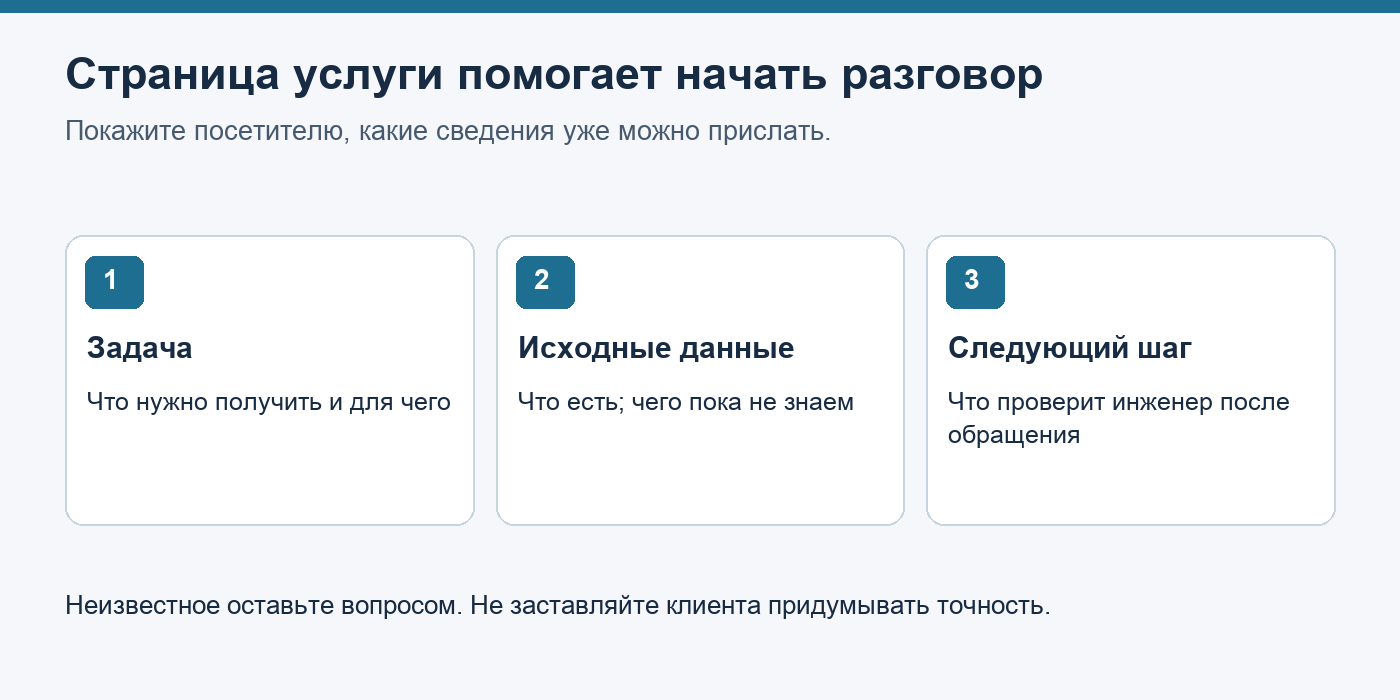
Give them a short brief they can complete without an engineer
- What is the product, and where is it used?
- What needs to be obtained, and what further work is it for?
- Is there a sample, drawings, 3D model, passport, or description? List what is available.
- What is currently preventing work from starting: missing dimensions, conflicting versions, or an unknown set of components?
- Are there constraints on deadlines, materials, or manufacturing? Which ones have already been confirmed?
Allow the answer “I don’t know.” It points to a question for the engineer. Required fields demanding invented precision produce poor initial data: the client will enter a random material or approximate dimension just to submit the form.
Show one completed inquiry
We need to prepare documents for reproducing a housing. There is one sample and an old PDF; the dimensions have not yet been checked. We plan to have it manufactured by a contractor. The material needs to be clarified, and no native files are included in this first message. We ask you to first determine what initial data is missing and what work is included in preparing the set.
This is a training example. It includes the objective, the state of the initial data, and a question for the specialist. It is more useful than the phrase “drawings turnkey,” even though the technical assignment has not yet been prepared.
Align the form with inquiry processing
Next to the button, explain what will happen after submission: who will review the inquiry and what first response the client will receive. Mention only a timeframe the team can meet. Do not ask people to upload confidential drawings publicly; first offer to agree on a method of transmission.
Test the form on a phone. Can the task be described without an attachment? Is a long message preserved? Is it clear that the inquiry has been sent? The contact channel should lead to an employee who can see the inquiry text, not just the phone number.
How to check the finished page
Ask a colleague who was not involved in writing the text to submit a training inquiry. Then pass it to the engineer without verbal explanations. If the engineer can name the next question and the preliminary scope of the review, the page supports the workflow. If you once again have to ask why the documents are needed and what is already available, refine the brief.
In our analysis on Workspace about the text of an engineering service shows an editor working with the inquiry “Can it be made from a sample?” For your own page, follow this principle: explain a specific situation, leave room for what is unknown, and promise a verifiable next step.